Your utility’s increases are already scheduled. Solar equipment gets more expensive December 4th. But because panels are ordered after you sign, the real window closes well before the date on the calendar.
Two prices are moving in New York this fall, in opposite directions. Understanding both takes about five minutes — and it’s worth those five minutes, because the timing here is unusual. Let’s start with the bill you already pay.
Your Electric Rates are Set Years in Advance
Most people don’t realize this: New York utilities can’t simply raise your rates whenever they want. They have to propose these rate increases first..
A utility files what’s called a rate case with the New York State Public Service Commission. Here, the utility explains what it wants to charge and why. Regulators, consumer advocates, and often local governments spend a year or more picking the request apart. The Commission then approves an amount, usually far less than what was asked for, frequently spread over three years.
The upside for you: because the process is public and slow, you can actually see your future rates before you pay them.
One thing to know first. Your electric bill has two halves: supply (the electricity itself, which fluctuates with the market) and delivery (the cost of the poles, wires, and crews that bring it to your house). The increases below are on the delivery side only as this is the part your utility actually controls. Supply charges go up too, however those don’t need pre-approvals.
Here’s what you can expect to see:
- National Grid: A three-year plan approved through 2028. April’s increase raised electric delivery costs 7.3%. Another increase is scheduled for 2027.
- Con Edison: Approved in January: average electric bills up 3.5% this year, 3.2% in 2027, and 3.1% in 2028. Each one builds on the last, so it’ll be close to a 10% increase over the next few years.
- NYSEG: Requested a 35% delivery increase, roughly $33 a month for a typical household. Small temporary rates took effect June 1 while the case continues. A final decision is pending.
- RG&E: Requested about $33 a month more on electric, a 26% jump to the total bill. Temporary rates also began June 1. Also still pending.
- Central Hudson: A multi-year plan approved, with more steps scheduled.
New York’s electricity rates already sit over 50% above the national average (4). With coming rate hikes, don’t wait to see what your bills will be – act now and lower your bills before you need to! If you wait and see you could be paying hundreds more on your bills this year alone.
Now the Other Side: What Happens December 4th
On August 6, the federal government signed a trade action on imported solar panels. It takes effect December 4, 2026 (1). It does two separate things, and they work very differently.
First: a 15% tariff
A tariff is a percentage added to the value of a product when it enters the country — think of it like a sales tax charged at the border. A panel worth $100 arriving in the U.S. would owe $15. Simple enough, and it’s the number most headlines lead with – but that’s not the whole story.
Second: a price floor of 38¢ per watt
This one is unusual, and it’s the part that actually costs you more.
A price floor isn’t a percentage. It’s a rule that says an imported panel cannot be sold below a set price, period. For finished panels, that minimum is 38 cents per watt. If a panel arrives priced under the floor, the company importing it gets charged the entire difference (2).
The distinction matters. A tariff makes cheap panels somewhat more expensive. A price floor removes cheap panels from the market entirely. There’s no longer a lower price for anyone to compete at.
Why “cents per watt” is the number that matters
Solar is priced by the watt. A single panel, for example, produces 440 watts, and a typical home needs somewhere between 8,000 and 12,000 watts of panels on the roof. So a few cents per watt sounds like nothing — until you remember you’re buying thousands of watts. This adds up quick.
Here’s how the two rules stack up. Imported panels have been selling around 26.5 cents per watt (3). The 15% tariff adds about 4 cents, bringing it to roughly 30.5 cents. But that’s still below the 38-cent floor — so the price gets pulled the rest of the way up to the minimum.
The tariff adds about 4 cents. The floor adds another 7.5 cents on top of it. All told, about 11.5 cents more per watt — and the floor is doing roughly three times the work of the tariff everyone is talking about.

What that means on an actual roof
The Hyundai 440 is a 440-watt panel. At 11.5 cents more per watt, that’s roughly $50 more per panel.
Most homes we work on use somewhere between 15 and 30 panels. So a smaller system runs about $750 more than it would today, an average one lands near $1,000, and a larger one climbs past $1,500 — all of it in panel cost alone.
Same panel. Same manufacturer, same warranty, same efficiency. Nothing about the product changes on December 4. Only the price does.
One honest note: this is the cost of the panels, not a prediction about your total quote. A solar project also includes the equipment that converts the power into the kind your house uses, plus mounting hardware, wiring, labor, permits, and inspection. Panels are typically only 15–20% of the whole. The mounting hardware and wiring already carry their own tariffs too — but the panel figure is the one we can point to a source for.
“Couldn’t I just buy American panels instead?”
Reasonable question, and partly right. American-assembled panels run around 31 cents per watt (3) — already under the new import floor, so they’re less directly exposed.
But two things. When the cheapest competing product gets legally repriced above you, prices tend to drift upward across the board. And most “American” panels are assembled here from cells manufactured overseas — and those imported cells carry the 15% tariff too.
Domestic isn’t immune. It’s less exposed. We install American-assembled options and will walk you through the tradeoff honestly.
Your Decision is Even More Simple
This fall it’s simpler. The thing you’re buying gets more expensive in December. The thing it replaces gets more expensive on a schedule.
Which brings us to one of the panels which will be highly affected by the tariffs: Hyundai. It’s our premium option, and right now it’s available at pre-tariff pricing, which is the part that changes.
Why choose Hyundai:
- More power from less roof. Current-generation cells, not closeout stock.
- All-black and clean on a roof. No silver grid lines. You’ll notice it every time you pull in the driveway.
- A 25-year product warranty. And it comes from a company whose name is on cars and ships, the kind still around when your warranty is old enough to matter.
- Built for here. Glass on both sides instead of plastic backing, so it handles snow and weather better. And panels lose output when they get hot — on a clear winter day, these can produce above their rated output.
Premium equipment is exactly what you want to buy ahead of a price floor. A floor lifts the bottom of the market, which squeezes the gap between good panels and cheap ones – you end up paying closer to premium pricing no matter what you choose. Right now, that gap still works in your favor.
One thing we’d rather you hear from us. Separately from the tariff, in June a group of American panel makers asked the Commerce Department to investigate solar cells made in South Korea – and Hyundai was named in that filing (5). No decision has been announced and we won’t predict one. But in similar past cases, considerably less product ended up reaching the U.S. We can’t promise this panel is available to us in 2027.
“Working with Kasselman Solar in creating an alternative primary energy source for my home turned out to be one of the best decision I could have made…If one is looking to work towards significantly reducing their electric dependence, Kasselman Solar is with whom you would want to work.”
Gregg S. | Stamford, NY
Why December 4th Isn't Really Your Deadline
This is the part that gets reported wrong constantly, and it’s the most practical thing in this article. The tariff applies based on when panels clear U.S. customs, the moment they legally enter the country, not when they’re installed on your house (2).
This actually tightens your schedule. Solar equipment is ordered for your specific project, not stored at our warehouse in bulk. We do keep small amounts of panels and other products in house, however majority is ordered! After you sign, we survey your property, pull building permits, and apply for your utility’s permission to connect the system to the grid. The equipment for your design is generally procured around the time that you sign, meaning you don’t want to leave this until last minute.
Sign in late November or December, and there’s actually a good chance your panels won’t clear customs until after the December 4th deadline. Your real deadline is weeks earlier than the one in the headlines.
There’s a second reason not to wait. The whole industry knows this date is coming. Expect heavy buying through October and November, and when every installer in the country reaches for the same inventory at once, allocations tighten and lead times stretch. The homeowners who signed in September aren’t the ones waiting.
What Isn't Changing
Here’s the reassuring part. The tariff is a federal measure on imported equipment, and New York’s incentives are untouched by it. The state still offers a 25% tax credit on your system, capped at $5,000 (6).
Batteries are worth a serious look while you’re at it, because New York pays for them twice. NYSERDA rebates knock money off your install cost up front, and after that your utility can pay you for letting the battery discharge during the handful of hours each summer when the grid is strained — real money every year, on top of keeping your lights on when the power goes out. Some households qualify for an enhanced rate worth considerably more. These incentives depend on your address and your household, so there’s no way to quote them generically. We’re a NYSERDA Platinum installer, and we’ll check every program you could be eligible for.
What You're Actually Buying
The tariff alone isn’t the reason to go solar. It’s the reason to stop waiting.
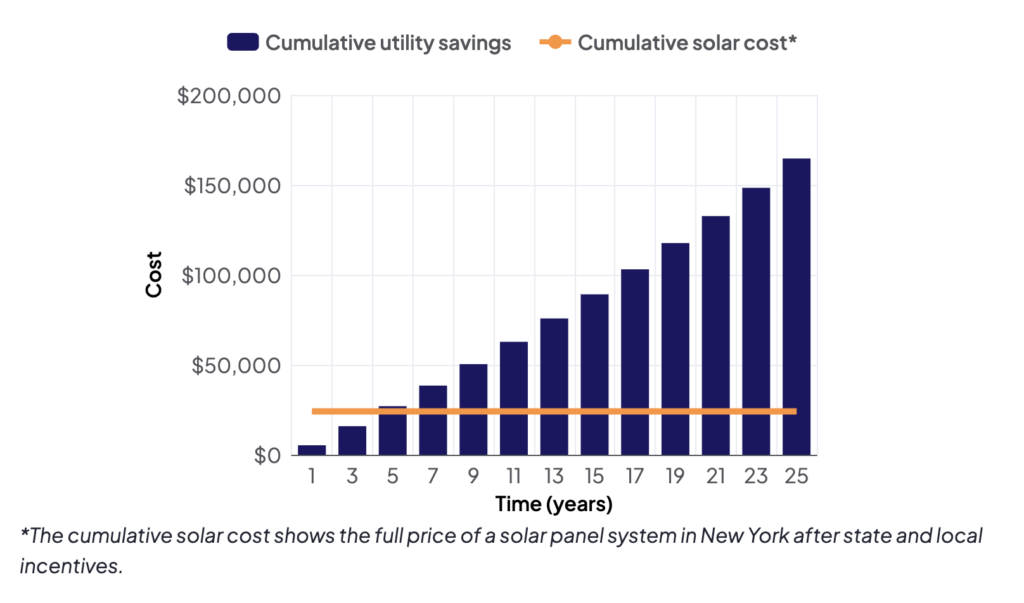
What solar can actually do is fix your price of electricity so that regardless of coming rate hikes and cost increases, you know what your cost is. Your system will produce the same electricity in 2040 as it will this year. That’s the real benefit to owning your own solar – lock in your rate for the next 25 years.
The math is pretty simple! Wait, and you’ll pay twice: the utility’s next increase, and December’s tariff. Get your free solar estimate today to see what you could save.
Frequently Asked:
Not on your total project price. The 38¢ floor sits about 43% above what imported panels sell for today, but panels are only 15–20% of an installed system. The equipment increase works out to about 11.5 cents per watt, or roughly $50 per panel.
No, but you should be signed well before it. The tariff attaches when panels clear customs, not when your system goes up. Equipment is ordered after you sign, and design, permits, and your utility’s approval all take time. Your installation itself can happen in winter or spring without changing your price.
The action actually targets the refined silicon that solar panels start out as — the same material used to make computer chips. The government treated it as a national security issue, then applied the rules all the way down the line to finished panels.
A tariff is a percentage added at the border, so a cheaper panel still costs less than an expensive one after it’s applied. A price floor is a hard minimum — no imported panel can be sold below it regardless of what it cost to make. That’s why the floor has a bigger effect on value-priced equipment.
No expiration date was attached. The Commerce Department can adjust the floor levels, so it isn’t necessarily permanent — but comparable tariffs on steel and aluminum have been in effect since 2018 and are still in place.
Published: 8/25/2026
Sources
- The White House. Adjusting Imports of Polysilicon and Its Derivatives Into the United States.
- Hunton Andrews Kurth LLP. US Imposes New Tariffs and Minimum Import Prices on Polysilicon and Solar Products.
- pv magazine USA. U.S. solar module prices face upward pressure as trade risks and FEOC rules dominate Q1 2026.
- Empire Center. New York’s Electricity Prices Fourth Highest in the Country
- pv magazine USA. Three U.S. solar companies file petition for AD/CVD investigation into South Korea.
- NYS Department of Taxation and Finance. Solar Energy System Equipment Credit.
- NYS Department of Public Service. Commission Grants Only a Fraction of NYSEG and RG&E Rate Request on Temporary Basis.