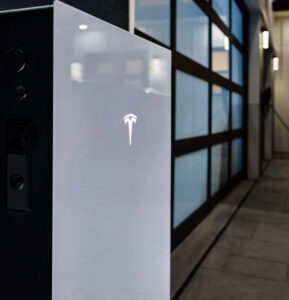
The Powerwall is the battery many homeowners ask us about by name. Some of that is brand recognition. Most of it, once you get into the details, is that it does a few things exceptionally well for a New York home.
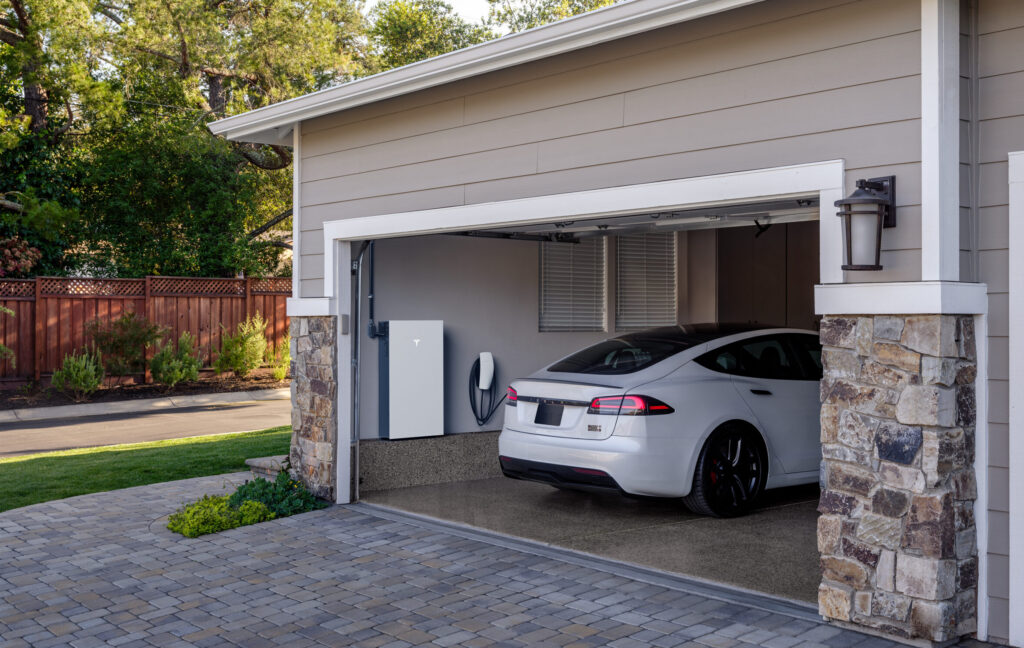
Tesla Powerwall 3: What it does
It can run the house, not just a few circuits.
The Powerwall 3 stores 13.5 kWh and is built to absorb the surge motors pull the second they switch on (1). That matters more here than the capacity figure does – a well pump draws hard for a moment when it kicks in, and a battery that can’t take that surge means no running water during an outage no matter how many kilowatt-hours it holds.
The switchover is instant.
With a generator, the power drops, you wait, you hear it start, and eventually the lights come back. The Tesla Backup Gateway takes over in a fraction of a second. Most people notice a flicker, if anything.
It charges itself before a storm.
Storm Watch tracks National Weather Service alerts for your area and tops the battery off automatically when severe weather is coming. You don’t have to be home, and you don’t have to remember.
It’s rated for New York winters.
The Powerwall 3 operates from -4 to 122 degrees Fahrenheit with a heating mode that keeps it ready in the cold (1).
Its inverter is built in.
Your panels connect straight to the battery: fewer components on the wall, cleaner install. And the Tesla app shows you power moving through your home in real time, what you’re running during an outage, and a slider setting how much of the battery stays reserved for your house no matter what.
When we'd recommend other batteries
The Tesla Powerwall 3 isn’t the answer for every house. For example, if you’re adding storage to solar you already own, you already have an inverter so FranklinWH or Enphase will likely be the better choice – both of which we offer currently. Deciding which battery is best for you can seem complicated, but our expert team will audit any existing systems and help you decide. Our goal is always to bring the best, custom system designs to each customer.
On top of the Tesla Powerwall 3, we also currently offer the 10C and 5P from Enphase’s lineup, and the aPower 2 and aPower S from FranklinWH’s offerings. Between all of these offerings, we’re able to customize both solar and battery storage to an individual’s needs.
What New York pays you
NYSERDA’s storage incentive is paid on usable kilowatt-hours and comes off your contract price before you sign (2). It’s not a rebate or a tax credit, so there’s nothing to file and nothing to wait for at tax season. Instead, you’ll see these savings come off upfront! And with our current 20% off battery storage promotion, you can maximize these savings.
| Where you are | Incentive Rate | Powerwall 3 | Powerwall 3 + expansion(s) |
|---|---|---|---|
| National Grid, NYSEG, RG&E, O&R, Central Hudson | $200/kWh | $2,700 | $5,000 |
| Con Edison | $250/kWh | $3,375 | $6,250 |
| Inclusive Storage Incentive (ISI) | $450/kWh | $6,075 | $11,250 |
The inclusive tier replaces the standard rate rather than stacking on it, and the state pays in blocks that step down as they fill, so your rate locks the day your application goes through. Most homeowners reach that tier by address rather than income, and the qualifying map covers more of Upstate than people expect (3). Check your address below and see in minutes if you’re eligible for these additional savings.
In addition to these upfront savings on your battery, there’s also a second payment. Once your battery is enrolled in your utility’s summer program, you’re paid annually on what it actually delivers – up to a few hundred dollars a season depending on your system and how many events it takes part in (4, 5, 6, 7, 8). These Dynamic Load Management (DLM) programs allow the utility to pull from your battery in extremely high usage scenarios during the summer. Read more on the full breakdown of both payments in our article, New York Pays You Twice for a Home Battery.
Your utility already accepts it
Here’s a step most homeowners don’t know exists. Most New York utilities only pay the NYSERDA incentive if your battery’s manufacturer is approved for that utility’s program and your enrollment is confirmed – pick a battery that isn’t on the list and you’re no longer eligible for those savings (9).
The Powerwall is accepted by the five below New York programs currently running. That isn’t true of every battery on the market, and it’s one of the practical reasons we carry it.
- National Grid: ConnectedSolutions
- NYSEG: Energy Storage Solutions Program
- RG&E: Energy Storage Solutions Program
- Orange & Rockland: Smart Savers Battery Program
- Con Edison: Bring Your Own Battery
Enrolling, where it applies, is your own approval in your battery’s app at commissioning. We walk you through it, but it’s your signature, not ours. Central Hudson is the exception right now. They don’t run a battery program yet, so there’s nothing to enroll in and the full incentive is claimable there today without it. That’s expected to change when they launch one (9).
Find out what your home qualifies for
Start with the address check or reach out directly for a no obligation consultation with our team. It’ll tell you on the spot whether you’re in line for the higher incentive rate, and we’ll follow up on what a Powerwall could look like for you.
20% off battery storage & 30% off rooftop solar - now through 11:59 PM September 30th
Offer details: 30% off solar and 20% off batteries available on new contracts signed by 11:59 PM on September 30, 2026. Incentive figures above are based on current published rates for a 13.5 kWh battery and are not a quote.
Frequently Asked
At 13.5 kWh, a Powerwall 3 earns $2,700 at the standard incentive rate across most of the state. That could go up to $3,375 or $6,075 based on location, or even $11,250 when adding expansions in certain areas.
Yes. Currently, Tesla is accepted by every New York utility battery program we currently operate in. Central Hudson doesn’t have a program running at this time, so the incentive is currently claimable there with no enrollment required.
Yes, it operates from -4 to 122 degrees Fahrenheit with a heating mode that keeps it ready in the cold. Capacity can dip in extreme cold, however we’ll help you plan for the every day and also the extremes.
Published: 9/4/2026
Sources:
- Tesla. Powerwall Product Documentation
- New York State Energy Research and Development Authority. Residential and Retail Energy Storage Incentives
- New York State Energy Research and Development Authority. Energy Storage for Your Home
- National Grid. ConnectedSolutions Battery Program
- New York State Electric & Gas. Energy Storage Solutions Program
- Rochester Gas and Electric. Energy Storage Solutions Program
- Orange & Rockland. Bring Your Own Battery
- Con Edison. Bring Your Own Battery
- New York State Energy Research and Development Authority. Utility Distributed Load Management Program Overview